
The Studio Journal
Wings Over Open Water: Marsh Mornings and the Goldeneye
By Boone Mercer
Most people will never understand the 4 a.m. alarm. You set it on purpose. You are glad when it goes off. And while the rest of the world reaches for the snooze button, you are standing at the edge of dark water with a thermos going cold in your hand, watching for the first hint of grey in the east.
I have stood at the edge of that water more mornings than I can count, and I will tell you something I believe: nobody gets up at that hour for the reasons people assume. They get up for the morning itself.
The decoys go out by feel as much as by sight, the water black and louder than it has any right to be. The dog is trembling, not from the cold but from wanting. Somewhere out in the dark you hear wings before you see anything at all, that ripping-silk sound of a flock passing low, and every head in the blind comes up at once.
Then the sky starts to break open. Slate first, then a seam of gold along the horizon, and the water catches all of it. For a few minutes the whole marsh is two skies, one above you and one below, with birds trading between them.
One morning on a backwater slough, I shared a blind with an old black dog and the man who had raised him. The shallows had skimmed with ice overnight, and when the first flock came through, low and fast and whistling, the old dog rose without a sound and simply watched, the way you would watch a door open on something you loved. Nobody said a word. Nobody needed to.
That is the hour. That is what the alarm was for. And I think it is why waterfowl paintings hang in so many homes. They are not really pictures of ducks. They are pictures of that hour.
What a Goldeneye Asks of a Painter
Of all the birds that cross that morning water, the goldeneye is the one I keep going back to. Old-timers call them whistlers, because that is what their wings do: you hear a goldeneye long before you see it, a fast, high whistle carrying across open water. And the drake is one of the sharpest-dressed birds out there, crisp white and black, a round white cheek patch, that bright golden eye, and a head that reads black until the light hits it. Then it flashes deep green, almost bottle-glass.
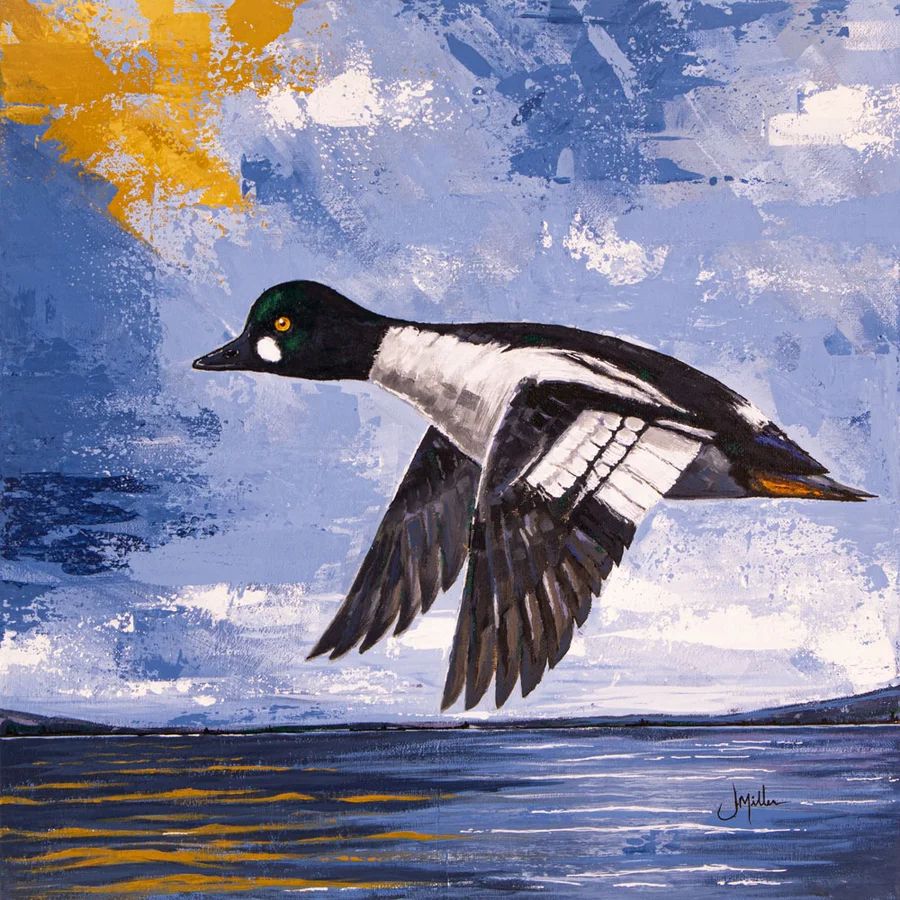
Ask anyone who has tried to put that flash in paint. The first decision is not the bird at all. It is where to put him, and what the sky is doing behind him. A drake sitting flat on a pond is a field-guide entry. A drake crossing the water at speed is the morning itself.
A bird in flight is a different problem from a bird at rest. Freeze him feather by feather and you lose the very thing you came for. The painters who get it right keep the brush moving the way the bird moves, one pass over another, until the speed lives in the paint: the blur at the wingtip, the hard edge along the back where the light lands, the water below holding the colors of the sky. Semi-impressionist is the word attached to Jeff Miller's acrylic work, and that is exactly what the word means in practice: paint the wingbeat, not the diagram.
The marsh will be there tomorrow at 4 a.m. Some of us will be standing in it, listening for whistlers.