
The Studio Journal
The Bugle at First Light: Painting the Bull Elk
By Boone Mercer
If you've heard it, you already know.
There is no good way to describe a bull elk's bugle to someone who hasn't stood in dark timber on a September morning and felt the sound come up through the cold. It starts low, almost a moan. It climbs into a whistle that doesn't seem possible from an animal that size. Then it breaks apart into deep, chesty notes you feel as much as hear. For a few seconds the whole mountain belongs to that bull, and everyone within earshot knows it.
I keep one of those mornings filed where I can reach it. A saddle below a long ridge, an hour before sunup, frost thick enough to creak underfoot. My partner and I had stopped to let our breathing settle, and the fog lay in the bottom of the drainage like a river that had forgotten to move. The first bugle came up from under that fog, thin and far off. The second answered out of the timber behind us, close enough to straighten my spine. We never saw either bull. It didn't matter. I have carried those thirty seconds for years.
That sound follows you out of the mountains. It shows up in January when you're scraping ice off a windshield. It shows up in the middle of an ordinary workday. Somewhere in the back of your mind there's a bull on a ridge at first light, and part of you is always walking back toward him.
Putting the Sound in Paint
Anyone who has watched a mature bull in full bugle knows he doesn't half-commit. The head goes back, the antlers lay along his spine, and the whole body leans into the sound. It lasts only a few seconds before he drops his head and goes back to being a shape in the trees. That's the moment a painting has to catch. Not a stiff field-guide pose. The real thing, mid-sound.
A painting is silent, which is the whole problem. Its job is to make you hear something that isn't there. Jeff Miller paints wildlife in acrylic, in a semi-impressionist style; he has said his elk work was inspired by trips to the mountain, seeing and hearing bulls bugling in the distance. The goal isn't counting every hair. It's getting the energy right: looser strokes where the body carries motion, firmer edges where the form has to hold, like the line of the antlers against the sky. Get the throat, the stretch of the neck, and the angle of the head right, and people who know the sound will hear it when they look at the canvas. Get it wrong and it's just a picture of an elk.
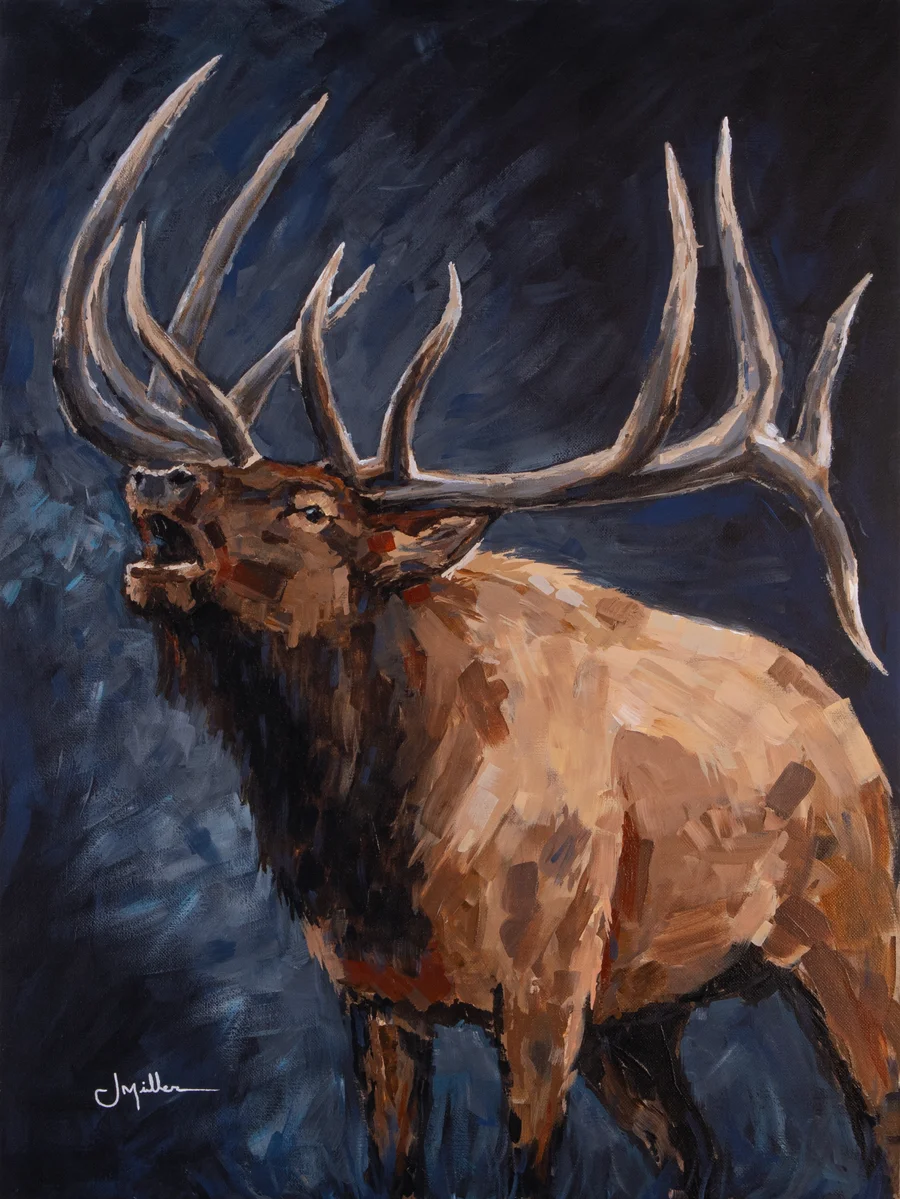
Light does the rest. First light in the high country is hard and low, and it picks out the edges of things. It leaves cool shadow down in the timber and puts a warm edge on whatever stands above it: a ridge line, a dead snag, the antlers and back of a bull. A painting of that moment ought to feel like that hour, because that's the hour the memory lives in.
Most of us only get a handful of those mornings a year, and none of us get them forever. A bugle lasts a few seconds. A painting of it, done honestly, can hold one on a wall for the rest of a life. But the sound itself stays free. Come September I'll be back in that saddle before sunup, breath hanging, waiting to hear the fog speak first.