
The Studio Journal
Big Country, Still Light: Mule Deer in the Open West
By Boone Mercer
There's a kind of country in the West that doesn't give anything up easily. Long sage flats running out to broken rimrock. Dry grass gone gold by October. Distances that make a truck on the far road look like a speck of dust. You can see thirty miles and still not see the one thing you came looking for.
That's mule deer country, and I think it's some of the most honest ground there is. You don't walk into it expecting anything. You walk into it willing to wait.
Glassing is its own discipline. You find a vantage before first light, settle in behind the glass, and start taking the country apart piece by piece. A shadow under a juniper. A line of brush in a dry draw. The edge where the grass meets the rock. Most of what you find is nothing. That's the deal. The land teaches you that looking and seeing are two different things, and that the second one takes patience the first never asked of you.
One October morning sticks with me. A friend and I climbed to a rimrock bench in the dark and sat wrapped in wool while the cold came up through the stone. The thermos lid steamed. Neither of us said much. For two hours we passed the glass back and forth over the same mile of broken country, and the only thing moving out there was the light. I have rarely felt more awake in my life.
The Way a Buck Materializes
Anyone who has glassed for mule deer knows this part. You've covered the same hillside four times. You'd swear it's empty. Then something shifts: an ear, a line that wasn't there before. And a heavy-antlered buck is simply standing in the open grass, the way he probably was the whole time. He doesn't arrive. He materializes. One second the hillside is sun-cured grass and shadow, and the next he's the only thing in it, and you realize you've stopped breathing.
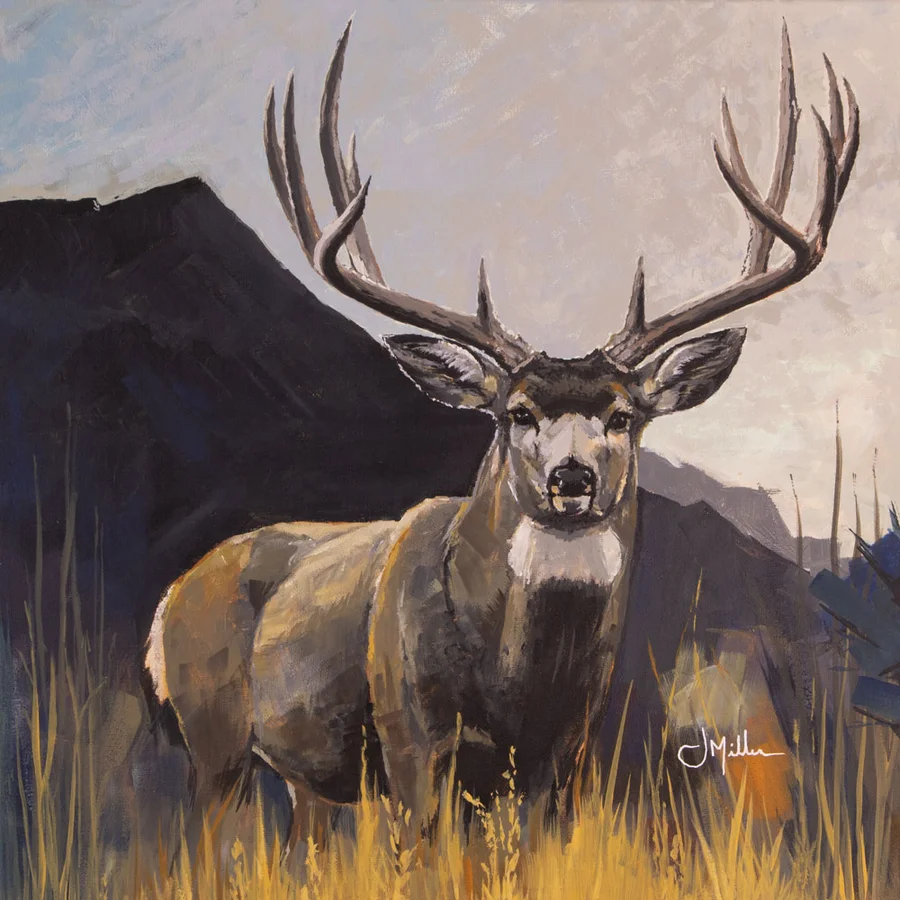
That held breath is the hardest thing to bring home, and I've come to believe it's the whole job of a wildlife artist. Jeff Miller, whose studio journal this is, paints in acrylic in a semi-impressionist style, which means the brush isn't counting every hair. It's after the light, the weight of the animal, the way the grass and the mountain hold him in place. Ask anyone who has tried to put late light in paint: hold it too tightly and it goes flat.
A camera can't do it either. If you've ever tried to show somebody a photo of a buck at four hundred yards in morning light, you know how much the lens lets go. The distance flattens. The light dies. The stillness, the part that mattered, doesn't come through at all.
The West doesn't hand out its best moments. You earn them with early alarms, long climbs, and a lot of empty hillsides before the one that isn't. Somewhere out there is a bench of rimrock with your name on it, and a morning where nothing moves but the light. Sit still long enough and the country will show you what it's been keeping.